
Why Malta?
The Best Wreck Diving in Europe
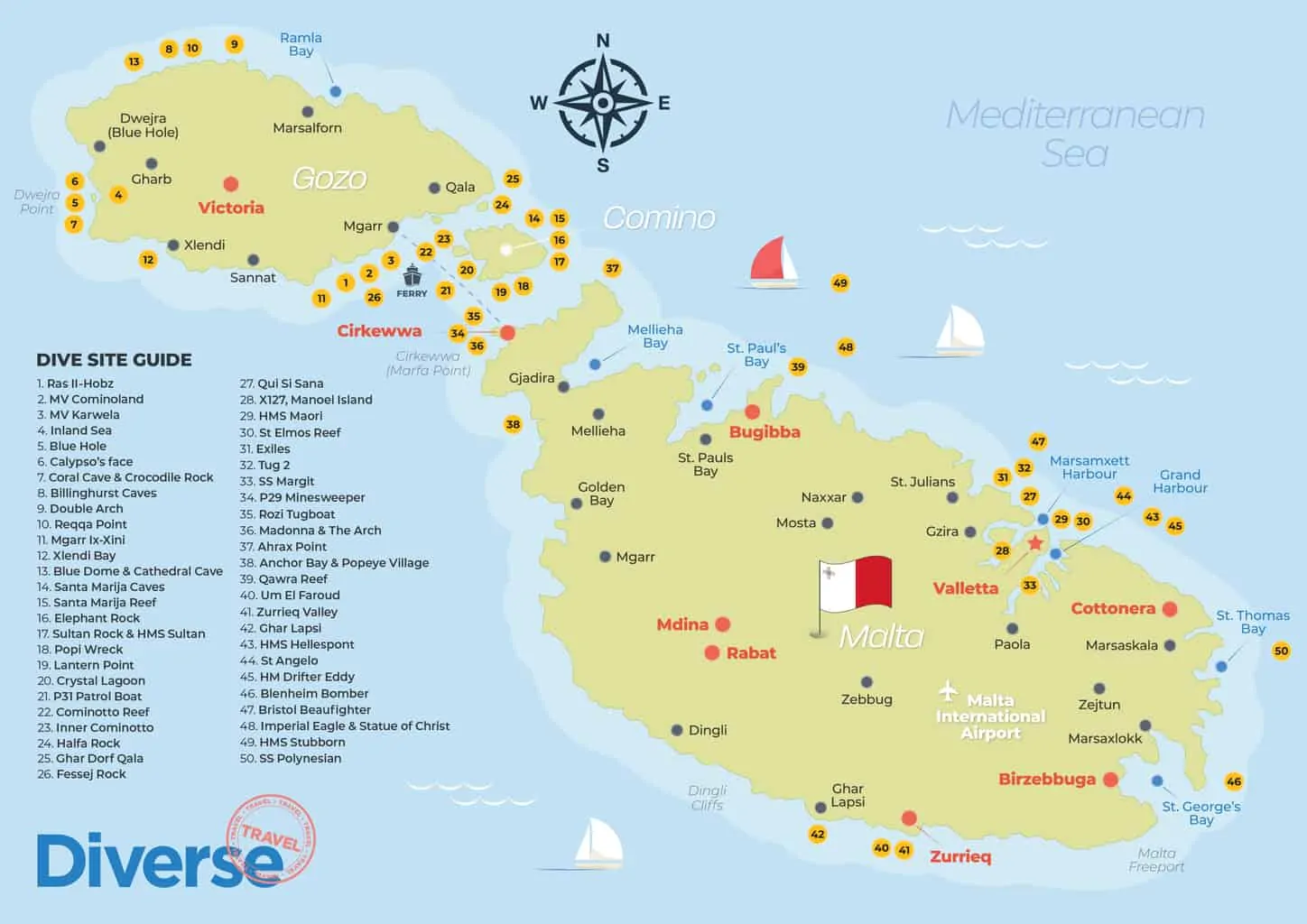
Malta consistently ranks as Europe's premier diving destination, and its crown jewel is its unparalleled collection of historic and purpose-scuttled wrecks. Unlike many global dive destinations that rely solely on natural coral reefs, the Maltese archipelago offers an underwater museum of maritime warfare, commercial history, and artificial structures. From intact cold-war minesweepers like the P29 to sprawling 109-meter oil tankers like the Um El Faroud, the quantity, variety, structural integrity, and historical depth of these wrecks are unmatched anywhere else on the continent. This site showcases the highlights.
Micro-Size, Maximum Accessibility
One of Malta's greatest advantages is its geographical size. The entire country is a compact archipelago, meaning you are never more than a 20-to-30-minute drive from a completely different coastline. If a fierce northwest wind blows out your planned dive at Cirkewwa in the north, you can still pack your kit into a car and be setting up for a sheltered dive at Wied iż-Żurrieq in the south within half an hour. Furthermore, Malta is unique because the vast majority of its world-class wrecks are shore dives. You do not need to rely on expensive, weather-dependent charter boats; you can simply gear up in a seaside parking lot and swim straight to a massive sunken vessel.
Affordability
Compared to remote tropical destinations or expensive Nordic technical diving hubs, Malta offers highly economical diving logistics. Because boat charters are optional rather than mandatory for major wrecks, the cost per dive drops dramatically. Air fills, nitrox upgrades, and equipment rentals are heavily subsidized by the sheer density of competing local dive centres. Combined with a massive range of budget-friendly self-catering apartments and highly competitive off-season flight paths from all major European airports, a world-class wreck itinerary here costs a fraction of standard international dive expeditions.
A Paradise for Non-Diving Buddies
You never have to worry about leaving non-diving partners or family members behind. Malta's rich historical footprint means that while you are avoiding deco limits on a deep wreck, your companions can explore 7,000 years of history just meters away. Every single dive site is directly adjacent to massive cultural hubs, open-air cafes, historic fortifications, and stunning rocky or sandy beaches. Non-divers can sunbathe, hike dramatic coastal cliffs, or tour ancient ruins, making it a perfectly balanced holiday for mixed-interest groups.
When to Go: Water Temperatures & Exposure Suits
The Maltese diving season runs year-round, but the thermal profile changes drastically across the four distinct quarters.
| Season | Water Temp Range | Recommended Exposure Suit Configuration |
|---|---|---|
| Winter (Jan – Mar) | 14°C – 15°C | Drysuit Layering. A drysuit paired with a mid-weight thermal undergarment (200g–300g) is highly recommended. Alternatively, a thick 7mm semi-dry with a hooded vest, gloves, and thick 5mm booties is the absolute minimum required to prevent rapid shivering on 45-minute profiles. |
| Spring (Apr – Jun) | 16°C – 20°C | Transition Phase. Early spring remains cold, requiring winter setups. By June, as the surface warms to 20°C, a high-quality 7mm full wetsuit or a 5mm wetsuit with a 3mm shorty/vest overlay is ideal. Thermal stratification (thermoclines) means deep wreck decks will feel significantly colder than the surface. |
| Summer (Jul – Sep) | 24°C – 28°C | Warm Water Configuration. The top 15–20 meters become beautifully warm. A 3mm or 5mm full wetsuit is perfect. Some hardy divers use a 3mm shorty, but a full suit is strongly advised to protect your skin against accidental scrapes on sharp wreck metal or unexpected stings from pelagic jellyfish. |
| Autumn (Oct – Dec) | 18°C – 24°C | The Repeat-Diver Secret. The sea holds onto summer heat far longer than the air. October boasts water temps around 22°C–24°C. A 5mm full wetsuit is perfect for October, while a transition back to a 7mm semi-dry or drysuit becomes necessary by late November as temperatures slide toward 18°C. |